How to Write Product Descriptions That Actually Sell | Proven Tips & Templates
Have you ever wondered how to write product descriptions that truly persuade customers to click “buy now”? In today’s competitive e-commerce world, where hundreds of products compete for attention, a product description is not just text on a page—it is your salesperson. The right words can transform hesitation into confidence and a simple browser into a loyal customer.
But here’s the problem: most product pages fail because they simply list technical details without making customers feel why the product matters. For example, saying “this phone case is made of plastic” is far less compelling than “this durable case protects your phone from accidental drops while keeping it sleek and stylish.” The secret lies in blending benefits with features, crafting messages that connect emotionally, and mastering copywriting for e-commerce.
So, how do you achieve this balance? How do you create descriptions that not only improve visibility with SEO optimization for product pages but also convert visitors into buyers? This guide will break down proven strategies, highlight real-world examples, and provide templates you can start using immediately. By the end, you’ll know exactly how to turn words into powerful selling tools.



The Power of Words in E-commerce
Why Product Descriptions Are Crucial
Online shopping removes the ability to touch, feel, or test products. That means your description is the bridge between uncertainty and purchase. Strong copy does what images alone cannot—it reassures, excites, and motivates.
Copywriting for E-commerce: The Hidden Sales Weapon
Unlike ordinary writing, copywriting for e-commerce uses psychological triggers. It tells customers not only what the product is but also how it improves their life. A dull description blends into the crowd, while a persuasive one sparks action.
How to Write Product Descriptions That Actually Sell
Step 1: Know Your Target Audience
Every word must be written with the buyer in mind. A 25-year-old fitness enthusiast doesn’t shop the same way as a 45-year-old parent. Tailoring your message to reflect their goals and struggles creates relevance.
Step 2: Benefits Over Features
This principle is key in feature vs benefit selling. Consider the difference:
Feature: “Water bottle holds 1 liter.”
Benefit: “Stay hydrated all day without constant refills.”
Benefits speak directly to customer desires, while features provide supporting evidence.
Step 3: Use Persuasive Language Naturally
Words like guaranteed, limited edition, proven, trusted build urgency and credibility. Avoid clichés—focus instead on emotions and outcomes.
Step 4: SEO Optimization Without Losing Flow
Your description must also be visible in search results. Strategic placement of keywords like seo optimization for product pages boosts rankings. For instance, creators following this Canva selling guide use clear, optimized descriptions to attract buyers without sounding robotic.
Structuring an Effective Product Description
Attention-Grabbing Headline
Keep it short, strong, and clear. Example: “Breathe Easy with Our Advanced Air Purifier.”
Engaging Body Copy
Start with the main benefit.
Support it with 2–3 features.
Use bullet points for quick scanning.
Adding Social Proof
Social proof reinforces trust. Reviews, testimonials, and even influencer mentions add weight to your claims. Sellers leveraging TikTok Shop have shown that pairing descriptions with authentic customer stories drives sales faster than product details alone.
Comparison: Features vs Benefits
| Feature | Customer Benefit |
|---|---|
| 100% Cotton | Comfortable, breathable, and long-lasting |
| Waterproof Material | Keeps items safe in rain or spills |
| 12-hour Battery Life | Enjoy uninterrupted use all day |
| Lightweight Design | Carry it anywhere without effort |
| Built-in Camera | Capture memories instantly and easily |
Case Study: Learning from Amazon Sellers
Amazon sellers provide an excellent example of balancing clarity, SEO, and persuasion. Successful sellers don’t stop at features—they highlight everyday benefits, answer objections, and integrate persuasive language. For deeper insight, explore this Amazon guide, which outlines how professional sellers present products effectively.
Best Practices for SEO Optimization in Product Pages
Place the primary keyword in the headline, introduction, and meta description.
Use secondary keywords naturally in body text.
Write for humans first, search engines second.
Add semantic terms like guarantee, premium, exclusive.
Ensure product specifications are accurate and detailed.
Link to trusted sources such as this resource on consumer psychology to add authority.
Template for Writing a Product Description
Headline: Short, benefit-driven statement
Introduction (2–3 sentences): Set the scene, highlight the main advantage
Bullet Points:
Key Feature → Related Benefit
Key Feature → Related Benefit
Key Feature → Related Benefit
Closing Line: Persuasive call-to-action, e.g., “Order today and enjoy fast, free delivery.”
The Psychology of Selling in Product Descriptions
Great product descriptions don’t just list details; they tap into customer psychology. Every buyer is driven by emotions first and logic second. When you write with this in mind, your words speak directly to hidden motivations.
Fear of Missing Out (FOMO): Phrases like “limited edition” or “only a few left in stock” create urgency.
Desire for Belonging: Highlighting community or lifestyle benefits—“Join thousands who trust this product daily”.
Trust and Security: Words such as “guaranteed, risk-free, trusted by professionals” eliminate hesitation.
Incorporating these elements into copywriting for e-commerce makes your product pages much more persuasive.
Common Mistakes to Avoid in Product Descriptions
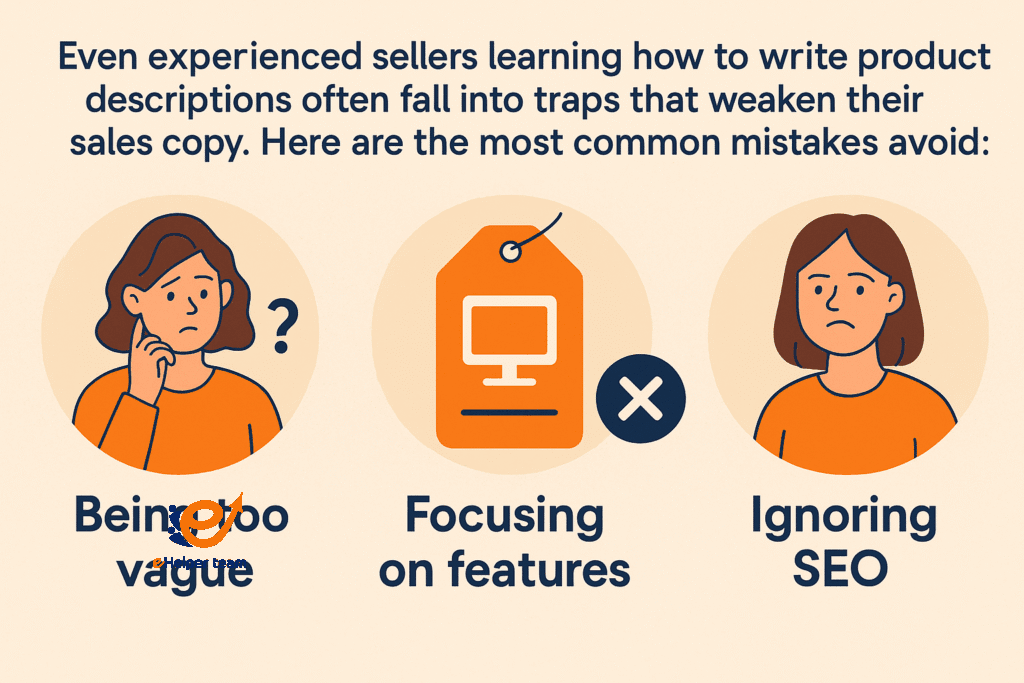
Even experienced sellers learning how to write product descriptions often fall into traps that weaken their sales copy. Here are the most common mistakes to avoid:
Writing for Yourself, Not the Customer
Don’t focus on what you like—focus on what your buyer values.Overloading with Technical Jargon
Unless your audience is highly technical, simplify your language.Ignoring SEO
Without proper seo optimization for product pages, your products won’t be found.Generic, Copy-Paste Text
Using manufacturer descriptions makes your store look unprofessional and risks duplicate content penalties.Forgetting the Call-to-Action
Every description should guide the reader to take action: “Buy now, Add to cart, Shop today.”
Advanced Tips: Storytelling & Sensory Language
1. Storytelling in Product Copy
Stories create emotional bonds. Instead of just describing a coffee mug as “ceramic with a handle”, tell a story:
“Imagine sipping your morning coffee from a warm, handcrafted mug that feels like it was made just for you.”
2. Using Sensory Language
Engage the senses to paint vivid pictures. Use words like:
Touch: silky, smooth, rugged
Sight: vibrant, crystal-clear, glossy
Taste/Smell: aromatic, zesty, refreshing
This makes the customer experience the product before buying.
Mini Case Study: Etsy Seller Success
An Etsy seller offering digital planners struggled with flat sales. Their original description said:
“Digital planner, PDF file, 100 pages.”
After applying feature vs benefit selling and persuasive copywriting, the description changed to:
“Stay organized and stress-free with this beautifully designed digital planner. Featuring 100 customizable pages, it helps busy professionals save time and focus on what matters most.”
Result? Their sales doubled in two months. This shows that when you combine SEO optimization with customer-focused benefits, your description becomes a conversion tool.
Frequently Asked Questions (FAQ)
Q1: What’s the main difference between features and benefits in product descriptions?
Features are product facts, while benefits explain why those facts matter to the customer.
Q2: How long should a product description be?
Between 100–300 words is ideal. It gives enough detail to inform but remains concise.
Q3: Should I include keywords in every product description?
Yes, but keep them natural. Overuse harms readability and search rankings.
Q4: What are common mistakes in writing product descriptions?
Using vague words, ignoring SEO, and failing to explain benefits clearly.
Q5: How can I make my descriptions unique for platforms like Amazon and Etsy?
By personalizing copy, adding storytelling, and using specific customer-centric language.
Conclusion: Turning Words into Conversions
how to write product descriptions, Mastering how to write product descriptions requires a mix of creativity, persuasion, and strategy. By focusing on benefits, weaving in persuasive language, and applying seo optimization for product pages, you transform simple text into powerful selling tools.
Without compelling descriptions, even the best products remain invisible. Investing in copywriting for e-commerce means investing in sales growth, brand credibility, and long-term success. For businesses ready to thrive online, building strong digital foundations is crucial—discover why in this detailed guide.